What is 0Gora?
0Gora — 0G + agora, the public square where knowledge was exchanged. A community-crowdsourced knowledge base, built on 0G. Ask it anything; every answer is grounded, cited, and verified on 0G.
For people and AI agents alike — humans use the web, agents connect over MCP. Same verified brain.
What it's for
- A shared, open knowledge base for any community or domain — not a walled garden.
- Answers you can trust: each is generated and TEE-verified on 0G, with citations. No black box.
- One source of truth your team and your agents can query.
Where it fits
- Project/protocol docs that answer questions (our live demo: a 0Gora about 0G itself).
- A community or DAO knowledge commons.
- An internal knowledge base with verifiable answers.
- A knowledge tool your AI agents can call — and trust.
Using 0Gora
Two front doors, one verified brain.
Humans — the web
Open 0gora.temporalabs.com/app. Pick a knowledge base from the
switcher (e.g. 0G or ERC-8226) when more than one is hosted, then ask — by default 0Gora auto-picks
the best 0G model for each query (a short Auto routed to… line shows which model answered and why); pin a
specific model from the picker if you prefer. Each answer shows inline citations [n] and a Verified on 0G
seal. If a question isn't in the corpus, 0Gora answers from general knowledge instead of guessing.
Agents — MCP
Connect over MCP (hosted, Streamable HTTP): https://0gora.temporalabs.com/mcp
claude mcp add --transport http 0gora https://0gora.temporalabs.com/mcp
| Tool | Args | Returns |
|---|---|---|
ask_0gora | question, model? | answer + citations + verification (verified, model, chatID) + routing (chosen, reason) when the model is auto-picked |
search_0g_knowledge | query, k? | raw passages + source URLs (no LLM) |
list_models | — | the verified 0G models |
model? accepts a specific id or "auto" (the default) to let 0Gora route. An agent gets knowledge it can
verify came from a TEE-attested model on 0G — not just text. See ../src/mcp/README.md.
Next: Why 0G? · Inside 0Gora
Why 0G?
0Gora's promise is trust — you can verify where every answer came from. That comes from 0G.
The 0G stack
0G is infrastructure for decentralized AI: four pillars. 0Gora builds on them (colored by what it uses today).
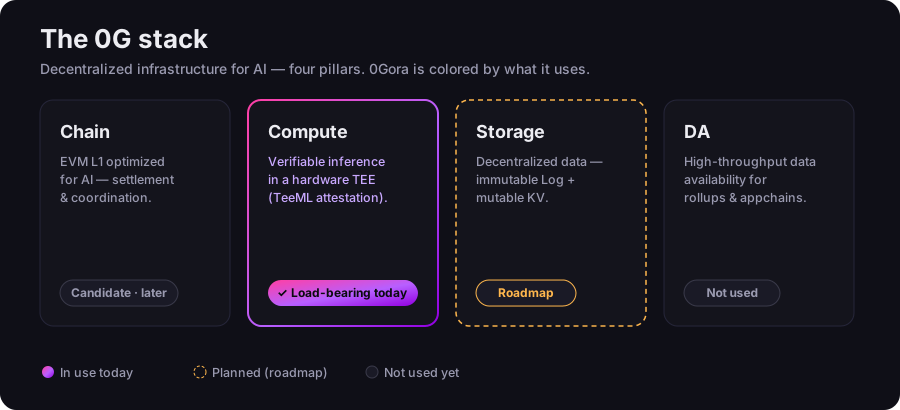
- Chain — EVM L1 for AI; settlement and coordination.
- Compute — inference inside a hardware TEE, attested (TeeML). The pillar 0Gora runs on.
- Storage — decentralized data: immutable Log + mutable key-value.
- DA — high-throughput data availability.
Concepts: https://docs.0g.ai/concepts.
What 0Gora uses
| Pillar | Today | Notes |
|---|---|---|
| Compute | ✅ load-bearing | Every answer generated + TEE-verified on the direct broker. Remove it, 0Gora can't answer. |
| Storage | ⛏ roadmap | Corpus is in Qdrant (off-chain) today; moving it to 0G Storage is next. |
| Chain | — candidate | Later: on-chain contribution / attribution. |
| DA | — unused | Out of scope. |
One pillar load-bearing (Compute), one planned (Storage), two unused.
Architecture
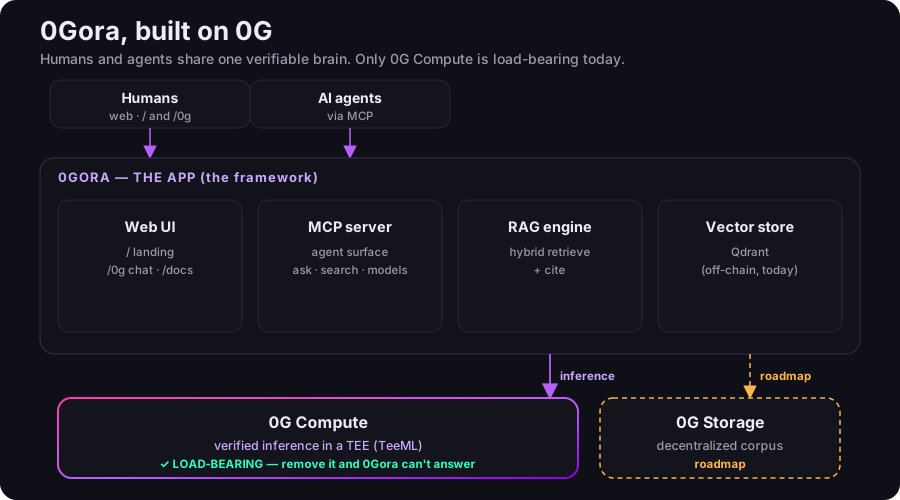
question → hybrid retrieval (Qdrant) → numbered context → generation on 0G Compute (TEE) → verified (processResponse) → answer + citations + seal.
What "Verified on 0G" means
Models run on the 0G direct broker with verifiability = "TeeML": sealed in a hardware TEE, each response
attested on-chain. 0Gora offers only TeeML models. Router-only models use TeeTLS (verifiable routing —
weaker), so e.g. GLM-5.2 isn't offered.
Model catalog
Four TEE-verified models. The picker defaults to Auto (below); 0GM is the routing default + fallback.
| Model | Lab | Lane (strengths) |
|---|---|---|
0GM-1.0-35B-A3B (default · fallback) | 0G Foundation | general, short — fastest, lowest cost |
zai-org/GLM-5.1-FP8 | Zhipu AI | reasoning, analysis |
deepseek-v4-pro | DeepSeek | code, math, logic |
qwen3.7-max | Alibaba | multilingual, long-context |
All on the direct broker, all TeeML. The broker serves others too (deepseek-v4-flash, glm-5,
qwen3.6-plus, gpt-5.4-mini, MiniMax-M3, …) — any can be swapped in via config. Per-model pages: https://pc.0g.ai/models.
Auto routing
By default 0Gora picks the best model per query — fast/cheap for easy turns, a specialist for hard ones — and that chosen model then generates and TEE-verifies the answer on 0G as normal. Two layers, cheapest first:
- Heuristic (free). Obvious queries route by rule with zero extra model calls: a greeting → the fast model;
a code fence /
def …/SELECT … FROM→ the code lane; math symbols → math; non-Latin script → multilingual; a very long query → long-context. - LLM classifier (cheap) — on 0G. For ambiguous queries, one short call on the cheap router model
(default
0GM) running on 0G returns the best model id. That routing call is unverified — it only picks a model, it isn't the answer, so it stays fast and cheap. The answer the chosen model produces is always TEE-verified, with its own Verified on 0G seal.
If the chosen model's 0G provider is momentarily unavailable, the answer cascades to the default (0GM) —
a query never dies because a specialist is unfunded. The footer shows which model actually answered
("⤷ Auto routed to …").
Routing is config-driven: the roster (models + their lanes), the default, and the router model all live in
0gora.config.json — strengths drives the choice, tier is advisory context for the classifier. Tune routing
by editing config, no code change. Prefer a specific model? Pin it from the picker to bypass Auto.
Next: Inside 0Gora
Inside 0Gora
For developers: how 0Gora works, and how to run your own. The reusable framework lives in src/; a
deployment is a small config folder under examples/ that drives it (the shipped one is
examples/0g/). You found your own agora by
copying that folder and editing config — you never touch src/.
0Gora's RAG design is influenced by Onyx; the implementation here is its own, built for this cup.
Retrieval (RAG)
- Ingest — fetch a URL / site / sitemap → clean (trafilatura) → chunk → embed (
bge-small) → store. - Query — hybrid retrieval: vector search (Qdrant) + BM25 keyword, fused with Reciprocal Rank Fusion (RRF) → top-k passages.
- Ground — passages become numbered context; the model cites them inline as
[n]. - Relevance gate — if the top match is weak, skip retrieval and answer from the model's general knowledge (no citations) instead of refusing.
Corpus & storage
- The corpus is a Qdrant vector store. Each record = embedding + text + source URL.
- Updated by re-ingesting sources (re-run ingestion on a URL → chunks refreshed). Admin-curated today; open contribution is on the roadmap.
- Off-chain today; 0G Storage is the planned home, so the data layer is on 0G too.
Components
| Service | Role |
|---|---|
| RAG API (FastAPI) | ingest, retrieve, generate · endpoints /chat, /search, /models, /config, /instances (co-hosted agoras) |
| 0G inference (Node) | OpenAI-compatible front to the 0G broker; runs the model in a TEE and verifies (processResponse) |
| MCP server | agent surface (ask / search / list models / list agoras) |
| Web | landing, chat, docs |
| Qdrant | vector store |
Deploy your own
0Gora runs as Docker containers wired by Docker Compose. The base compose in src/deploy/ defines the generic
services; an example's compose.override.yml layers its config on top:
git clone https://github.com/TemporaLabs/0gora
cd 0gora
cp examples/0g/.env.example examples/0g/.env   # set your 0G wallet key (or keep ZEROG_MOCK=true)
docker compose -f src/deploy/docker-compose.yml \
               -f examples/0g/compose.override.yml \
               --env-file examples/0g/.env up -d --build
That brings up the RAG API, the 0G inference service, the MCP server, the web app, and Qdrant. The instance's
branding, example questions, and seed corpus come from examples/0g/0gora.config.json — no secrets, mounted at
runtime. Seed the corpus with examples/0g/seed.sh. Add -f src/deploy/docker-compose.prod.yml for TLS in
production.
Optional voice input. Off by default. To enable: set "voice": { "enabled": true } in
0gora.config.json and deploy with the voice compose profile (--profile voice, or
COMPOSE_PROFILES=voice in .env). That runs the self-hosted src/stt
service (faster-whisper) — the mic then transcribes on-box (works in any browser, audio never leaves the
stack). Without the profile, nothing voice-related is built or run, so the default deploy carries zero footprint.
Found your own: the fastest path is the scaffolder — npm create 0gora@latest my-agora clones the
framework and generates a configured examples/<slug>/ for you. (By hand: copy examples/0g to
examples/<your-topic>, edit 0gora.config.json and .env, bring it up with your folder's overlay.) Same
framework, a brand-new verifiable agora.
Use one (agents): npx 0gora-mcp connects any MCP agent to a running 0Gora, or drop in the
src/skill/ skill to teach an agent to join one
and found its own.
Next: What is 0Gora? · Why 0G?
Kept short on purpose — writing style inspired by the caveman principle (less is more), not fully emulated. · Built originally for the 0G Zero Cup · ← back to 0Gora